
342270

Carbon disulfide
ReagentPlus®, low benzene, ≥99.9%
조직 및 계약 가격을 보려면 로그인를 클릭합니다.
크기 선택
보기 변경
제품정보 (DICE 배송 시 비용 별도)
실험식(Hill 표기법):
CS2
CAS 번호:
Molecular Weight:
76.14
EC Number:
200-843-6
UNSPSC Code:
12352100
PubChem Substance ID:
Beilstein/REAXYS Number:
1098293
MDL number:
Assay:
≥99.9%
Bp:
46 °C (lit.)
Vapor pressure:
5.83 psi
vapor density
2.67 (vs air)
Quality Level
vapor pressure
5.83 psi
product line
ReagentPlus®
assay
≥99.9%
form
liquid
autoignition temp.
212 °F
purified by
glass distillation
expl. lim.
50 %
dilution
(for general lab use)
impurities
<0.05% water, <1 ppm Benzene
evapn. residue
<0.0003%
refractive index
n20/D 1.627 (lit.)
bp
46 °C (lit.)
mp
−112-−111 °C (lit.)
density
1.266 g/mL at 25 °C (lit.)
SMILES string
S=C=S
InChI
1S/CS2/c2-1-3
InChI key
QGJOPFRUJISHPQ-UHFFFAOYSA-N
Application
Carbon disulfide can be used as a solvent:
- To synthesize hydroxynaphthyl ketones via Friedel-Crafts acylation and demethylation.
- In the regioselective bromination of binaphthols.
Legal Information
ReagentPlus is a registered trademark of Merck KGaA, Darmstadt, Germany
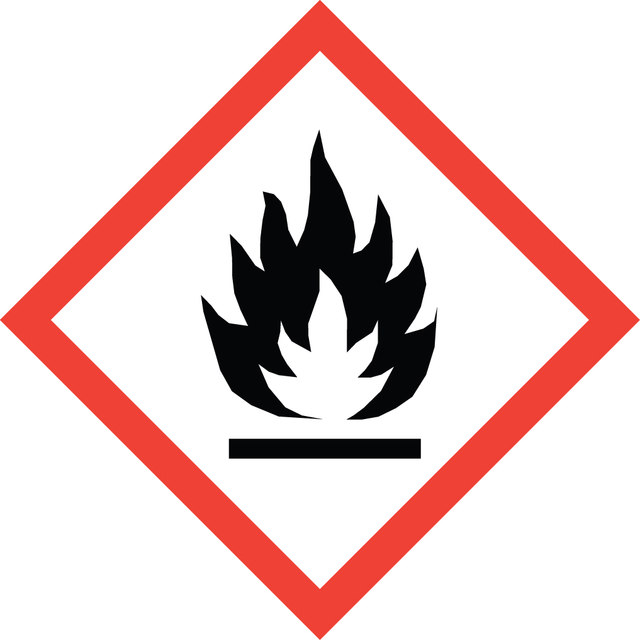


signalword
Danger
Hazard Classifications
Acute Tox. 4 Inhalation - Eye Irrit. 2 - Flam. Liq. 2 - Repr. 2 - Skin Irrit. 2 - STOT RE 1
target_organs
Peripheral nervous system,Central nervous system,Cardio-vascular system,Eyes
저장 등급
3 - Flammable liquids
wgk
WGK 2
flash_point_f
-22.0 °F - closed cup
flash_point_c
-30 °C - closed cup
Loric Büchler et al.
Forensic science international, 318, 110590-110590 (2020-12-06)
Arsonists may use ignitable liquids to start, accelerate and amplify fires. The sampling of volatiles present on the hands of suspected arsonists is therefore sometimes carried out in the course of the investigation of (possible) deliberate fires. Several collection protocols
Mark B van Eldijk et al.
Chemical communications (Cambridge, England), 49(71), 7770-7772 (2013-06-19)
CS2 hydrolase, a zinc-dependent enzyme that converts carbon disulfide to carbon dioxide and hydrogen sulfide, exists as a mixture of octameric ring and hexadecameric catenane forms in solution. A combination of size exclusion chromatography, multi-angle laser light scattering, and mass
Huan Liu et al.
Journal of hazardous materials, 235-236, 298-306 (2012-08-21)
Chemical conditioners are often used to enhance sewage sludge dewaterability through altering sludge properties and flocs structure, both affect odorous compounds emissions not only during sludge conditioning but also in subsequent sludge disposal. This study was to investigate emission characteristics
국제 무역 품목 번호
| SKU | GTIN |
|---|---|
| 342270-100ML | 04061826757062 |
| 342270-1L | 04061826757079 |