
Protocol Guide: Generation of Apical-Out Gastrointestinal Organoids
Apical-Out Organoids
Stem cell-derived organoids have become an increasingly important model to study normal and pathological states of the mucosa. Intestinal organoids preserve several critical functions of the gut epithelium including barrier integrity, polarized secretion and absorption, innate immune responses, and the presence of multi-lineage differentiation. However, traditional 3D culture methods using basement membrane extracts (BME) produce an “apical-in” phenotype, making access to the luminal inner surface of the epithelium difficult. Advanced microinjection techniques have been used to interrogate these interior apical cell types which are not conducive to high-throughput assays or imaging. A recent study described a protocol to reverse the polarity of 3D organoids, making them “apical-out”.1 Apical-out organoids facilitate assay of the luminal compartment of cells and expand the possibilities of organoid use in gastrointestinal health, drug screening, ADME/toxicity studies, and disease research. We have successfully generated apical-out gastric, ileum, and colon patient-derived organoids (PDOs) following this culture protocol and created a co-culture of gastric organoids with H. pylori to model host/pathogen interactions.
References
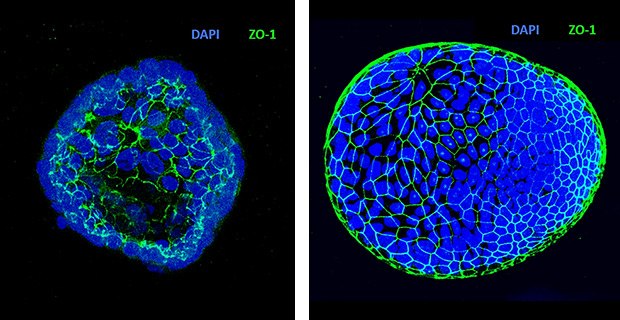
Figure 1.Generation of Apical-Out Human Colon Organoids. Epithelial cell polarity of 3dGRO™ Human Colon Intestinal Organoids (SCC321) were reversed using the apical-out organoid culture protocol. Polarity reversion was analyzed by immunocytochemical staining with Dapi (Blue) and ZO-1 (MABT339, Green), a marker of cell-to-cell tight junctions within luminal apical cells.
Apical-Out Organoid Generation Protocol
- Culture organoids in Matrigel® basement matrix domes for 4-5 days following standard organoid protocols in growth media such as L-WRN conditioned media (SCM105).
- Dislodge domes and use a wide-bore pipette tip to solubilize in PBS without Ca2+ or Mg2+ (BSS-1006) containing 5 mM EDTA (E9884) for 1 hr at 4°C on a rotating platform.
- Centrifuge organoid suspension for 3 minutes at 200 x g at 4°C; remove supernatant. Be careful to completely remove any residual basement matrix.
- Resuspend pelleted organoids in growth medium such as L-WRN conditioned media (SCM105) in a Costar® ultra-low-attachment tissue culture plate (CLS3473).
- Incubate at 37°C, 5% CO2 for 72 hr.
- Check organoids under microscope to confirm eversion. Apical-out organoids may be used for downstream applications or maintained in media in ultra-low-attachment culture plate for up to 2 weeks.
Immunofluorescence Staining of Apical-Out Organoids
Immunofluorescence staining was carried out according to the established Protocol Guide: Immunofluorescent Staining of Whole-Mount Organoids using Antibodies.
Cryopreservation of Apical-out Organoids
- Culture apical-out organoids in suspension with organoid growth media such as L-WRN conditioned media (SCM105) for 1-3 days following steps above.
- Collect organoids and pellet 200 x g for 3 minutes at 4°C.
- Resuspend organoids in fresh complete organoid growth media with 10% v/v DMSO (D2650).
- Freeze vial(s) slowly overnight at -80°C in Mr. Frosty™ container. Transfer vial(s) to liquid nitrogen.
- To recover organoids, thaw quickly at 37°C. Resuspend in organoid growth media and culture for desired assay.
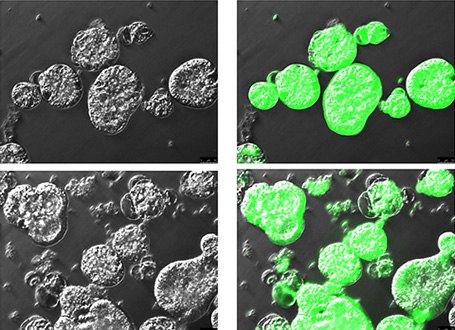
Figure 2.Cell Viability Staining of Cryopreserved Apical-out Organoids. 3dGRO™ Human Ileum Intestinal Organoids (SCC339) were cryopreserved and cell viability was analyzed using a Calcein-AM staining dye (17783) at day 8 and 13 following thaw. Apical-out organoids remain highly viable after cryopreservation and thaw when cultured in organoid growth media such as L-WRN conditioned media (SCM105).
Organoid Barrier Integrity Assay Protocol
- Culture apical-out organoids in suspension with organoid growth media such as L-WRN conditioned media (SCM105) for 1-3 days following steps above.
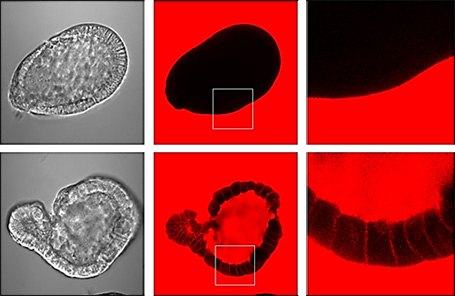
- Collect organoids and pellet at 200 x g for 3 minutes at 4°C. Resuspend sample in organoid growth medium containing 2 mg/mL TRITC-dextran (T1037). For disrupted barrier control, resuspend control organoids in Hank’s Balance Salt Solution (without Ca2+ or Mg2+) (BSS-1006) containing 2 mM EDTA (E9884) and incubate 15 minutes on ice.
- Transfer organoids to chamber slide suitable for confocal microscopy and immediately image at appropriate channel, capturing brightfield and fluorescence images.
Infection of Apical-Out Gastric Organoids with H. pylori
- Culture apical-out organoids in suspension with organoid growth media such as L-WRN conditioned media (SCM105) for 1-3 days following steps above.
- After 72 hr of culture in ultra-low attachment plates, infect organoids with H. pylori strain 26695 (ATCC Cat. 700392) at a multiplicity-of-infection (MOI) of 100. Grow H. pylori in Brucella Broth (B3051) supplemented with 10% FBS (F2442) for 18 hr at 37°C in agitation before the infection.
- 24 hr after infection, collect the organoids and wash with PBS for 5 min and pellet at 200 x g for 5 min at 4°C. Repeat two additional times.
- Fix the organoids with 4% PFA for 30 min and wash with PBS and stain with antibodies using Protocol Guide: Immunofluorescent Staining of Whole-Mount Organoids using Antibodies.
- Image the organoids in a confocal microscope.
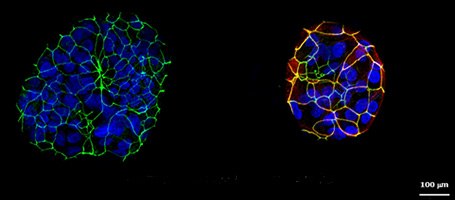
Figure 4.Generation of Apical-out Gastric Organoids. Epithelial cell polarity of 3dGRO™ Human Gastric Organoids (SCC344) were reversed using apical-out culture protocol. Organoid polarity reversion was analyzed by immunocytochemical staining with Dapi (Blue), Actin (Red) and ZO-1 (MABT339, Green), a marker of cell-to-cell tight junctions within apical luminal cells.
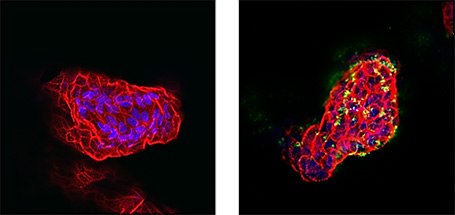
Figure 5.H. pylori Infection of Apical-out Gastric Organoids. Apical-out 3dGRO™ Human Gastric Organoids (SCC344) were infected with H. pylori for 24 hr followed by immunocytochemical staining with Dapi (Blue), Actin (Red) and H. pylori antibody (Dako Cat. B0471).
Materials

계속 읽으시려면 로그인하거나 계정을 생성하세요.
계정이 없으십니까?