Accéder au contenu
MilliporeSigma

33801

L-(+)-Tartaric acid

99.5-101.0% (calc. to the dried substance), powder or crystals, puriss. p.a., reag. ISO

Synonyme(s) :

(2R,3R)-(+)-Tartaric acid, L-Threaric acid

Se connecter pour consulter les tarifs organisationnels et contractuels.

Sélectionner une taille de conditionnement

Changer de vue

A propos de cet article

Formule linéaire :
HO2CCH(OH)CH(OH)CO2H
Numéro CAS:
Poids moléculaire :
150.09
NACRES:
NA.21
PubChem Substance ID:
UNSPSC Code:
12352100
EC Number:
201-766-0
MDL number:
Beilstein/REAXYS Number:
1725147
Assay:
99.5-101.0% (calc. to the dried substance)
Form:
powder or crystals
Service technique
Besoin d'aide ? Notre équipe de scientifiques expérimentés est là pour vous.
Laissez-nous vous aider


Nom du produit

L-(+)-Tartaric acid, puriss. p.a., reag. ISO, 99.5-101.0% (calc. to the dried substance)

Quality Level

agency

Ph. Eur., USP/NF, reag. ISO

vapor density

5.18 (vs air)

grade

puriss. p.a.

assay

99.5-101.0% (calc. to the dried substance)

form

powder or crystals

optical activity

[α]20/D +12.0 to +12.8°, c = 20% in H2O

autoignition temp.

797 °F

impurities

≤0.0005% heavy metals (as Pb)

ign. residue

≤0.1% (as SO4)

loss

≤0.1% loss on drying, 105 °C

mp

170-172 °C (lit.)

anion traces

chloride (Cl-): ≤5 mg/kg, phosphate (PO43-): ≤10 mg/kg, sulfate (SO42-): ≤150 mg/kg

cation traces

Ca: ≤20 mg/kg, Cu: ≤5 mg/kg, Fe: ≤5 mg/kg, Pb: ≤2 mg/kg, Zn: ≤5 mg/kg

SMILES string

O[C@H]([C@@H](O)C(O)=O)C(O)=O

InChI

1S/C4H6O6/c5-1(3(7)8)2(6)4(9)10/h1-2,5-6H,(H,7,8)(H,9,10)/t1-,2-/m1/s1

InChI key

FEWJPZIEWOKRBE-JCYAYHJZSA-N

General description

L-(+)-Tartaric acid is an organic acid naturally found in grapes and wines. It is widely used as flavoring agent and antioxidizing agent for various beverages (grape juices and wines). It can be synthesized starting from L-ascorbic acid (AA, vitamin C). Its forms various hydrogen-L-tartrate salts, which have important applications in crystal engineering studies. Its quantification in grape juice has been carried out by recording HPLC chromatograms.

Application

L-(+)-Tartaric acid may be employed as starting reagent in the synthesis of enantiomeric forms of pyrrolidinoisoquinoline derivatives.


Still not finding the right product?

Explore all of our products under


pictograms

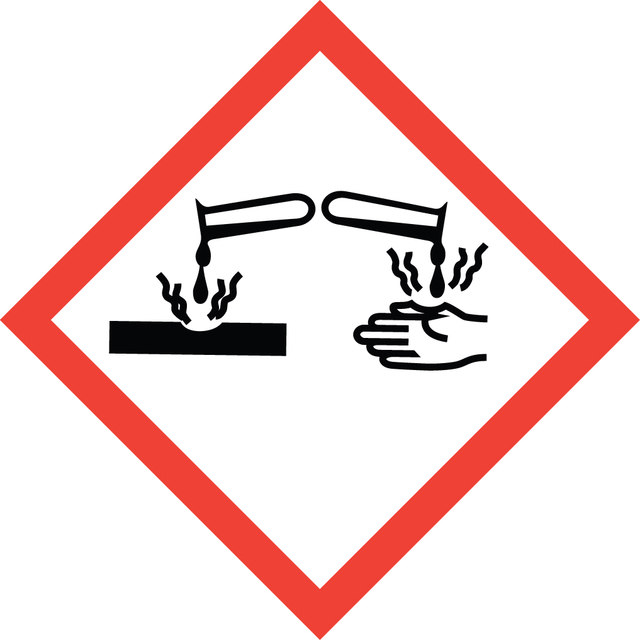
Corrosion

signalword

Danger

hcodes

Hazard Classifications

Eye Dam. 1

Classe de stockage

11 - Combustible Solids

wgk

WGK 1

flash_point_f

302.0 °F - closed cup

flash_point_c

150 °C - closed cup

ppe

dust mask type N95 (US), Eyeshields, Gloves


Faites votre choix parmi les versions les plus récentes :

Certificats d'analyse (COA)

Lot/Batch Number

Vous ne trouvez pas la bonne version ?

Si vous avez besoin d'une version particulière, vous pouvez rechercher un certificat spécifique par le numéro de lot.

Déjà en possession de ce produit ?

Retrouvez la documentation relative aux produits que vous avez récemment achetés dans la Bibliothèque de documents.

Consulter la Bibliothèque de documents


Protocoles

Silica gel G 254 plates are suitable for analysis of Dextromethorphan following the European pharmacopeia monograph.


Organic acid profile of Turkish white grapes and grape juices.
Soyer Y, et al.
J. Food Compos. Anal., 16(5), 629-636 (2003)
Asymmetric synthesis of both enantiomers of pyrrolidinoisoquinoline derivatives from L-malic acid and L-tartaric acid.
Lee YS, et al.
The Journal of Organic Chemistry, 60(22), 7149-7152 (1955)
Seth DeBolt et al.
Proceedings of the National Academy of Sciences of the United States of America, 103(14), 5608-5613 (2006-03-29)
The biosynthetic pathway of L-tartaric acid, the form most commonly encountered in nature, and its catabolic ties to vitamin C, remain a challenge to plant scientists. Vitamin C and L-tartaric acid are plant-derived metabolites with intrinsic human value. In contrast


Numéro d'article de commerce international

RéférenceGTIN
33801-1KG-R04061835562800
33801-250G-R04061826744109