
Self-Propagating Reactions Induced by Mechanical Alloying
Introduction
Mechanical alloying is a “brute force” method of affecting alloying and chemical reactions. The mixture of reactant powders and several balls are placed in the milling jar of a high-energy ball mill, for example, a shaker mill or a planetary mill (Figure 1). The collisions and friction between the balls, and between the balls and the wall of the container, result in deformation, fragmentation, mixing, and cold-welding. The reactivity increases due to defect formation and increased interface area, and eventually alloying and/or chemical reactions take place. Neither additional heat nor solvent are needed. The product is a powder that can be consolidated using the usual methods of powder metallurgy. Mechanical alloying is a very flexible technique and has been used to prepare a broad variety of materials, including dispersionstrengthened alloys, amorphous alloys, and nanocomposites.1 High-energy ball milling is also called mechanochemical processing when used, often in conjunction with other steps, for inorganic synthesis, the processing of minerals, and the activation of building materials.2
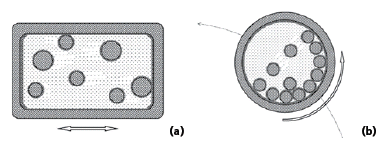
Figure 1.Cross section views of the milling vial of a shaker mill (a) and a planetary mill (b).
Mechanically-induced Self-propagating Reactions (MSR) are possible in highly exothermic powder mixtures.3 Initially, milling results in activation, similar to any other mechanical alloying process. But at a critical time, called the ignition time, the reaction rate begins to increase. As a result, the temperature rises, further increasing the reaction rate and eventually leading to a self-sustaining process. Most of the reactants are consumed within seconds. At this stage, the reaction is similar to thermally ignited self-propagating high-temperature synthesis (SHS).4 The abrupt temperature increase is detectable on the outer surface of the milling container and its presence distinguishes such mechanically induced self-propagating reactions (MSR) from gradual processes (Figure 2). MSR can happen in a broad variety of systems, such as in Fe2O3–Al, Ni–Al, Ti–C, Zn–S, and Mo–Si mixtures.3 The ignition time is an important attribute of the process; it can vary from a few seconds to several hours depending on the reaction and the milling conditions.
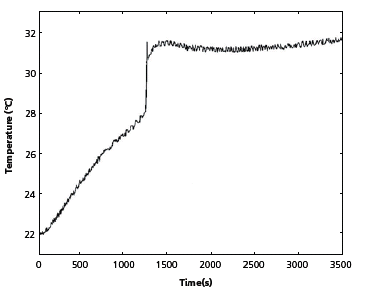
Figure 2.Temperature of the outside surface of the vial during ball milling of a 5 Ni + 2 P mixture in a SPEX 8000 Mixer Mill. Ignition is indicated by the rapid temperature rise at 1220 sec. The gradual temperature increase before ignition is caused by dissipated mechanical energy.
The investigation of MSR contributed considerably to our understanding of mechanochemical processes in general. The variation of the ignition time with process conditions and material properties tells us about the mechanism of the activation process, while detailed studies of partially activated powders provides information about the nature of the critical state. MSR has also been considered as a practical means for the production of useful materials, particularly refractory compounds.3
Requirements For Self-Sustaining Reactions
MSR (as well as SHS) require sufficient self-heating to propagate the reaction. A measure of self-heating is the adiabatic temperature, defined as the final temperature, if all the reaction heat is used to heat the products. A rule of thumb is that self-sustaining reactions are possible, if the adiabatic temperature is at least 1800 K. Since the main issue is self-heating at the beginning of the reaction, the quantity –ΔH298/C298 (where H298 and C298 are reaction enthalpy and specific heat at 298 K), written simply as ΔH/C, is often used as a simpler substitute for adiabatic temperature; ΔH/C > 2000 K is the condition for MSR. This simple condition applies surprisingly well to the most frequently studied classes of reactions, namely combination reactions between a transition metal and a metalloid element (e.g. Ti-B, Nb-C, Mo-Si, Ni-P) and thermite-type reactions between an oxide and a more reactive metal (e.g. Fe3O4-Al, CuO-Fe, ZnO-Ti). Much lower values of ΔH/C are sufficient for MSR with chalcogenides and chlorides. Table 1 contains data for a few typical reactions.
As more exothermic reactions become increasingly easy to self-sustain, reactions with higher adiabatic temperatures are expected to require shorter activation times before ignition. Such a relationship indeed exists, but only if the other material parameters and the milling conditions are very similar. So far, the best correlation was observed for the reduction of CuO (Prod. No. 203130, 450804, 450812), NiO (Prod. No. 203882, 637130, 481793), Fe3O4 (Prod. No. 310069, 518158, 637106), Cu2O (Prod. No. 208825, 566284), and ZnO ( Prod. No. 204951, 255750, 544906), with the same metal (Ti, Zr or Hf).3 These are ductilebrittle systems5 where milling results in a fine dispersion of the oxide particles in the metal matrix. The development of the microstructure depends primarily on the ductile component and it is kept the same for each series.
The changes caused by mechanical milling during the activation period—decrease of grain size, mixing, and formation of lattice defects—depend mainly on the mechanical properties of the reactants. Although it is difficult to quantify this relationship, the increasing width of the X-ray diffraction lines indicates that the crystallite size decreases and the accumulated lattice strain of the metal component increases as the powder approaches ignition.6,7 While reducing the grain size and thereby increasing the interface area is certainly a key component of the activation process, agglomeration is also necessary to ensure efficient matter and heat transfer. An interesting case is the reduction of MoS2 (Prod. No. 234842) with aluminum powder (Prod. No. 202584, 653608). This reaction is gradual, although ΔH/C = 2093 K is well over the accepted threshold for an MSR process. However, MoS2 prevents agglomeration, reducing the area of the active interface.8
The mechanical intensity of the milling action depends on the number and energy of the collisions between the milling balls and between the balls and the container wall. The charge is characterized by the ball-to-powder mass ratio, a parameter approximately proportional to the rate of specific energy input. For typical milling conditions, ignition takes place when the powder has received a critical amount of mechanical energy and the ignition time is inversely proportional to the ball-topowder mass ratio. If too much powder is used, the energy of each individual impact is distributed in a very large volume and the stresses are not large enough to cause activation. If the amount of powder is too little, the heat loss to the milling tools and to the atmosphere quenches any incipient selfsustaining reaction.
Understanding Mechanically Induced Self-Propagating Reactions
A mechanical alloying experiment may look quite simple, but the underlying process is very complex consisting of the components on very different length and time scales. Thus, the complete modeling of a mechanochemical event requires an adequate description of the macroscopic processes, such as the operation of the mill, the collisions between the milling balls, and the transport of the powder within the milling container. On the microscopic scale, the effect of an individual collision on the powder caught between the impacting surfaces must be understood and the formation of lattice defects and the elementary interface reactions must be described. Significant advances were made toward a general theory of gradual mechanical alloying by Prof. Courtney and his students.9
The key moment of an MSR is ignition. Once we understand what makes the state of the material critical at ignition, we should be able to use this understanding of MSR for learning about the initial phase of other mechanical alloying processes. Unfortunately, many details are system specific and identifying the general features is consequently difficult. Whether ignition takes place or not may be very sensitive to composition and milling conditions. For example, Figure 3 shows the X-ray diffraction patterns of two x(Zn+S) + (1–x)(Sn+2S) mixtures.10 This is an unusual system as the combination reactions.
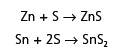
are both self-sustaining, but the process is gradual in mixtures of the two for 0.19 < x < 0.45. The pairs of patterns shown in Figure 3 represent two samples just below and above the lower limit. After 33 min of milling, the state of the samples is practically identical. Minutes later MSR takes place in the sample with x = 0.185 and the reaction is practically complete a few seconds later. No ignition is observed in the powder with x = 0.2 and there is little chemical change close to 33 min of milling in this sample. Nevertheless, the powders react gradually and complete transformation is observed after extended milling.
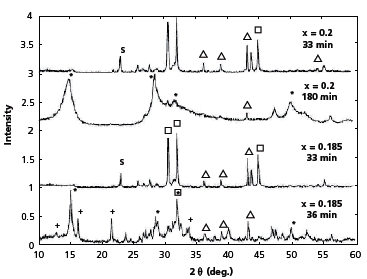
Figure 3.X-ray diffractograms of two x(Zn+S) + (1–x)(Sn+2S) mixtures. The main lines of Sn ( ), Zn (Δ), S, SnS (x), SnS2 (*) and Sn2S3 (+) are indicated.
A simple model can be used to describe the degree of activation with an ignition temperature, Tig.,7 i.e. the temperature at which the reaction becomes self-sustaining upon heating. It appears that the ignition temperature decreases with milling, until it becomes lower than the temperature of the hot spots between the colliding balls. At that moment ignition occurs. The advantage of this picture is that the ignition temperature can be determined independently from heating curve measurements. Dramatic reduction of the ignition temperature was indeed found in some systems (e.g. Ti–Si–C but not in others such as Mo–Si)11,12. Relaxation and oxidation can be part of the reason; the conditions during uniform heating and ball milling are also very different.
Usually only a fraction of the milled powder is floating around inside the milling vial as free dust. The majority of the material forms a thin coating over the surface of the balls and the walls of the container. The initial hot spots of ignition are created in this coating as small sections of it are compressed energetically between the colliding balls.9 Whether it expands or extinguishes is a small-scale SHS issue, which depends on the balance between the reaction heat, the local heating, and the heat dissipation into the surrounding powder. A distinguishing feature of MSR is the importance of the heat loss to the milling tools3 that can delay or prevent ignition if the powder layer is thin (meaning the amount of powder in the container is small).
Examples and Applications
The reduction of a metal oxide with a reactive metal is the most widely studied class of reactions due to the large number of systems with the required high adiabatic temperature. For example, the reduction of CuO with iron is exothermic enough to support an MSR,7 and reactions between an iron oxide and metals like Al or Ti are also selfsustaining. 3,13 There are many combinations in between. Therefore, it is possible to select groups of reactions where one property varies in a systematic way while the others remain nearly constant. For example, CuO, NiO, Fe3O4, Cu2O, and ZnO (in order of decreasing adiabatic temperature) were reduced with the Group IVB metals Ti (Prod. No. 268496, 366994), Zr (Prod. No. 403288, 403296) and Hf (Prod. No. 266752). Surprisingly, the ignition time was the shortest with Zr for each oxide; in the case of Cu2O the variation is more than an order of magnitude larger (Figure 4).13 This is one of the few examples where the chemical behaviors of Zr and Hf are so different.
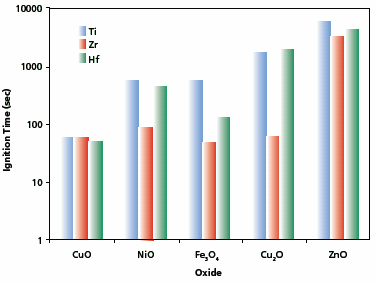
Figure 4.Ignition times of Mechanically Induced Self-propagating Reactions between Cu, Ni, Fe and Zn oxides, and Ti, Zr, and Hf metals.
The formation of NiAl from a mixture of elemental powders is an example of a metal-metal reaction that proceeds as an MSR.14,15 The experimental conditions need to be selected very carefully, otherwise the reaction progresses gradually. As a rule, however, the formation of other intermetallic compounds is either not exothermic enough, or the efficient heat dissipation to the milling tools prevents ignition in purely metallic systems.
MSR is a promising method for the preparation of refractory metal-metalloid compounds because it is fast, simple, direct, and uses the heat generated by the process itself to reach high temperatures. The main difficulty is that the product is non-uniform and agglomerates immediately after the self-sustaining process. Continued milling can remedy the problem, although it increases the processing time and the possibility of contamination from the milling tools. MoSi2 (Prod. No. 243647) attracted early attention, as it is the primary material of heating elements up to 1700 °C.6,12 As the reaction between Mo and Si is not very exothermic and two different phases of MoSi2 can form, obtaining uniform product by milling molybdenum and silicon is difficult. The binary carbides, borides and silicides of Ti, Zr, and Hf can be prepared much easier by MSR.13 Furthermore, Ti3SiC2 is a very promising material that combines the high temperature oxidation resistance of ceramics with a level of ductility usually found in metals. The preparation of this compound was successfully carried out by an MSR synthesis using elemental powder mixtures.16 It is worth noting that due to the possible formation of several phases in the Ti–Si–C system, obtaining the desired single-phase material requires that process parameters be selected and controlled very carefully.
Incorporating nitrogen into an intermetallic compound is always difficult. Ambient nitrogen was used to prepare carbonitrides by milling Nb (Prod. No. 262722, 262749), Ta (Prod. No. 262846, 545007) or Hf with carbon in a planetary mill.17 The milling container was permanently connected to the nitrogen supply via a rotary valve and flexible tubing. The composition could be controlled over a wide range by adjusting the carbon content.
MSR and SHS are related processes and both have been utilized for the preparation of refractory compounds. They can also be combined into a process called mechanically activated SHS (MASHS).18 In MASHS, the mixture of powder components is activated by ball milling, then the powder is pressed into a block and the reaction is ignited thermally in a separate step. Mechanical activation lowers the ignition temperature and results in a more stable combustion process producing a more uniform product than a conventional approach. An interesting example is the formation of FeSi2 from a mixture of iron (Prod. No. 255637, 209309, 267953) and silicon (Prod. No. 215619, 267414, 475238) powders.
The adiabatic temperature of this reaction is only about 1300 K. Thus, neither conventional SHS nor MSR seem possible. Indeed, neither could be observed. However, utilizing the MASHS process, an appropriate mechanical activation by ball milling increases the reactivity in the system and makes an SHS in a separate step possible.
Conclusion
MSR is an interesting variation of mechanical alloying that contributed substantially to our understanding of the chemical transformations facilitated by ball milling. It also forms a base for potential applications, either alone or in combination with other processing techniques. In particular, it is promising for the preparation of refractory materials.
Materials
References
To continue reading please sign in or create an account.
Don't Have An Account?